Quick summary
- The E90 sedan and E92 coupe 328i use BMW’s naturally aspirated N52 inline-six, rated at 230 hp and 200 lb-ft.
- A rear-drive sedan weighs about 3,362 lb; xDrive adds roughly 220 to 245 lb and costs one to two mpg.
- Budget for the electric water pump, the oil filter housing gasket, and the valve cover gasket before anything else.
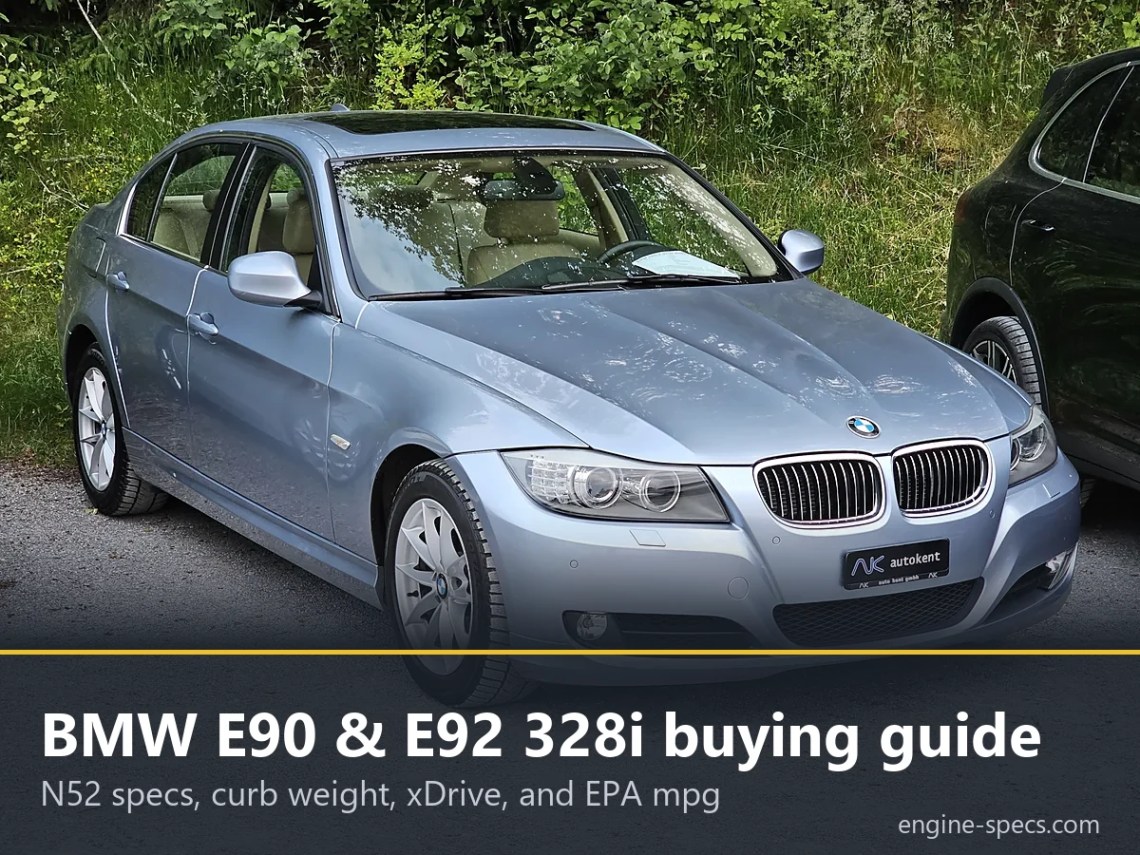
Short answer: the 328i is the naturally aspirated E9x — the N52 inline-six, 230 hp and 200 lb-ft, in the E90 sedan, E92 coupe, E91 wagon, and E93 convertible. The condition that decides what one costs to own is service history rather than mileage: the electric water pump and two gaskets fail with age on every one of these cars. The limit is tuning headroom — if that is the goal, the twin-turbo 335i is the car instead, and it costs considerably more to keep.
Engine specs: the N52 inline-six
| Spec | US-market E90/E92 328i |
|---|---|
| Engine | 3.0-liter naturally aspirated inline-6 (N52B30) |
| Output | 230 hp @ 6,500 rpm / 200 lb-ft @ 2,750 rpm |
| Construction | magnesium-aluminum composite block, Valvetronic + double VANOS |
| Transmissions | 6-speed manual or 6-speed automatic |
| Drivetrain | RWD; xDrive AWD optional (328xi/328i xDrive) |
| 0–60 mph | 6.3 s manual / 6.9 s automatic (2009 sedan, BMW rating) |
| Curb weight | 3,362–3,428 lb (RWD sedan); xDrive adds about 200–245 lb |
| EPA fuel economy | 18 city / 28 hwy / 21–22 combined mpg (RWD sedan) |
The N52 is the calm sibling of the twin-turbo N54 that powered the 335i: no turbos, no high-pressure fuel pump drama, no injector saga — just an efficient, free-revving six that won international engine awards in 2006 and 2007. It asks for premium fuel to make its full rating, though the penalty for regular is mild on a naturally aspirated engine — the mechanics of that trade-off are in our octane guide.
Curb weight by body style and drivetrain
Weight is the number owners ask about most, and it varies by more than 500 lb across the range. The figures below are BMW’s published curb weights for each body with the 328i’s N52 engine, manual / automatic:
| Body (chassis code) | 328i RWD | 328i xDrive (AWD) |
|---|---|---|
| Sedan (E90), 2009 | 3,362 / 3,428 lb | 3,605 / 3,649 lb |
| Coupe (E92), 2011 | 3,362 / 3,428 lb | 3,583 / 3,627 lb |
| Sports Wagon (E91), 2010 | 3,527 / 3,594 lb | 3,770 / 3,814 lb |
| Convertible (E93), 2011 | 3,825 / 3,891 lb | not offered |
Three patterns stand out. In BMW’s figures the coupe weighs the same as the sedan despite two fewer doors. The retractable hardtop makes the convertible the heaviest 328i by roughly 460 lb over the sedan. And the automatic adds about 65 lb to a rear-drive car but only about 45 lb to an xDrive car. Optional equipment such as the sunroof, sport seats, or navigation adds more, so an individual car on a scale will usually read a little higher.
328i vs 328xi / 328i xDrive
BMW sold the all-wheel-drive version as the 328xi for the 2007 and 2008 model years and renamed it 328i xDrive from 2009. The engine is identical; the differences are weight, acceleration, and fuel economy:
| 2009 sedan | 328i (RWD) | 328i xDrive (AWD) |
|---|---|---|
| Curb weight, manual / auto | 3,362 / 3,428 lb | 3,605 / 3,649 lb |
| Weight distribution, front / rear (manual) | 50.5 / 49.5% | 52.6 / 47.4% |
| 0–60 mph, manual / auto | 6.3 / 6.9 s | 6.9 / 7.1 s |
| EPA city / highway / combined | 18 / 28 / 21–22 mpg | 17 / 25 / 20 mpg |
The xDrive car carries about 220–245 lb more, shifts weight toward the nose, and gives up 0.2–0.6 seconds to 60 mph and 1–2 mpg combined. In exchange it offers far better traction in rain and snow. The mechanical checklist above applies to both; the xDrive adds a transfer case and front differential to inspect, and mismatched tire wear between axles can strain the transfer case — replace tires in sets of four.
Fuel economy by body
EPA ratings for the 328i barely moved over the generation. Representative figures from the EPA’s fueleconomy.gov database, city / highway / combined mpg:
| Model | Manual | Automatic |
|---|---|---|
| 2011 328i sedan | 19 / 28 / 22 | 18 / 28 / 22 |
| 2011 328i xDrive sedan | 17 / 25 / 20 | 18 / 25 / 20 |
| 2011 328i coupe | 19 / 28 / 22 | 18 / 28 / 22 |
| 2011 328i Sports Wagon | 17 / 26 / 20 | 18 / 26 / 21 |
| 2011 328i convertible | 17 / 26 / 20 | 18 / 26 / 21 |
Real-world results depend on condition as much as on the window sticker: a failing thermostat that keeps the engine running cold, or a leaking oil filter housing gasket, will cost more fuel than the choice of body.
What actually breaks
Reliable is not the same as free. Three items account for most N52 ownership costs, and all three are age-driven, so assume any car that lacks receipts still needs them:
Electric water pump. The N52 pioneered BMW’s electric coolant pump, and its plastic impeller grows brittle with age. Failures cluster roughly between 50,000 and 80,000 miles; when it dies the engine overheats even at idle. Replace it proactively with the thermostat — it is the single most important line item on an E9x budget.
Gasket leaks. The valve cover gasket and oil filter housing gasket both weep with age; the OFHG can drip onto the serpentine belt and take it out. Neither is expensive in parts; both are labor jobs.
VANOS solenoids and lifter tick. Sticky solenoids cause rough idle and hesitation and clean up cheaply; the N52’s occasional cold-start lifter tick is annoying but rarely consequential.
Routine care is simple and cheap by BMW standards — the E90 oil change guide covers the parts and intervals that actually matter.

Which year and body to buy
In the US the N52-powered 328i was sold from the 2007 model year through 2011 as a sedan, with the E92 coupe and E93 convertible continuing through 2013 and the E91 wagon through 2012. The LCI facelift (2009 model year for the sedan and wagon, 2011 for the coupe and convertible) brought revised lights and bumpers and small electronics updates — cosmetically worthwhile, mechanically the same engine throughout, which keeps the buying decision simple: condition and records beat year. The sedan is the practical pick; the E92 coupe’s longer doors and lower roof make it the looker. Manual cars carry a growing premium — a subject we covered in whether the manual still matters.
Two upgrades transform any survivor: fresh suspension bushings and dampers, and modern tires — our 335i tire guide applies unchanged to the 328i, and an alignment afterward (see camber, caster, and toe) makes the tires last.
The bottom line
The E9x 328i is the value entry into the last naturally aspirated straight-six 3-series: cheaper to buy and vastly cheaper to keep than a 335i, with a short and predictable list of known failures. Budget for the water pump, fix the leaks once, and it is one of the most durable ways into a proper BMW six.
Sources: BMW U.S. technical data for the 2009 3 Series Sedan and 2010 Sports Wagon; BMW Canada’s MY2011 3 Series Coupe & Cabriolet product guide (coupe and convertible weights, converted from kg); EPA fueleconomy.gov ratings; reliability patterns per long-term owner and independent-shop reporting, September 2026. Photos: Damian B Oh (CC BY-SA 4.0) and OSX (public domain) via Wikimedia Commons.